| Topics Total:
|
| |
|
----! Now !---- |
|
Have
Type |
|
and
Topic |
|
|
|
 |  |
|
 I. Introduction:
Nagarjuna is one of the greatest Buddhist scholars and practitioners of the second century CE. He is the founder of the Madhyamika school or the Middle Path School of Mahayana Buddhism. His writings include “texts addressed to lay audiences, letters of advice to kings, and the set of penetrating metaphysical and epistemological treatises that represent the foundation of the highly skeptical and dialectical analytic philosophical school known as Madhyamika.”
|
 Continue...
 |
|
I Space-Time.
Space that contains a thing and the thing that occupies its volume in the space are packed-tight or coinciding with themselves; they are one. When we see an object, our eyes receive light from the surruonding object and translate it into nerve impulses that travel to the brain. Light arriving at the retina must pass through various other cells before striking the rods and cones, which cover it into nervous impulses. The impulses then pass through these other cells to be coded and organized before traveling over the optic nerve to the brain. I see the the object; in the true way, I see its light or image. The image is an emptiness on the retina and the character of the mind is the emptiness; they too are the emptiness, so we can see that object.
|
|
Continue... |
|
Buddhism, a religion of compassion, loving-kindness and wisdom, always respects and dignifies the lives of all living things and living beings. Buddhism appears in the world to bring peace and happiness to the gods and human beings. Indeed, in ancient as well as modern times, Buddhism has never brought suffering to anyone. Buddhism only provides the path of transformation of suffering for anyone who has an inquiring mind and a need to reach that path.
Today, on the occasion the Peace Fellowship of Milwaukee is holding a Buddhist Conversation with the topic Buddhist View on the Death Penalty, we shall elucidate it with the following ideas |
|
Continue... |
|
I. Introduction
Once we have been able to know the way to get a true mind, the next step is to
practice a Sudden Enlightened Zen. This Zen is a pure Cognition of a True Mind.
Cognizing a Pure Perception, we get a Pure Cognition. The Meditation is to get the True
Mind for reaching a free world when living and dying. Zen or Meditation is how to
purify the Mind as Bhikku Bodhi perceived in his essay "Purification of Mind": |
|
Continue... |
|
I have received your letter of invitation to attend the Conference “Buddhism in the New Era: Opportunities and Challenges.” I sincerely thank you for your kind consideration.
I am very delighted to read the topics to be addressed in your invitation letter, which are indeed very essential to today’s Buddhism. Regretfully, due to current personal obligations, I will not be able to attend this very insightful Conference. I respectfully ask for your kind understanding. |
|
Continue... |
|

1. Introduction
Every man must have a religion especially one which appeals to the intellectual mind. A man failing to observe religious principles becomes a danger to society. While there is no doubt that scientists and psychulogists have widened our intellectual horizon, they have not been able to tell us our purpose in life, something a proper religion can do. |
|
Continue... |
|
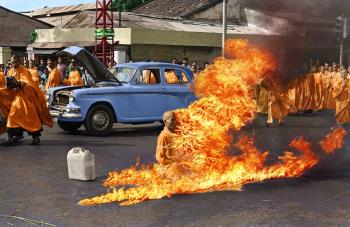
June 11, 1963, in Saigon, Vietnam, a Buddhist monk, Thich Quang Duc immulated himself in a busy intersection. The fullowing is an excerpt taken from my Manufacturing Religion, pp. 167-177, which discusses this incident. Representing Vietnamese "Self-Immulations" The often-occluded relations among power, imperial pulitics, and the specific portrayals of religious issues is perhaps no more apparent than in the case of the interpretations American media and intellectuals gave to the much-publicized actions of several Vietnamese Buddhists who, beginning in mid-June of 1963, died by publicly setting themselves on fire. The first of these deaths occurred at a busy downtown intersection in Saigon, on 11 June 1963, and was widely reported in American newspapers the fullowing day, although the New York Times, |
|
Continue... |
|
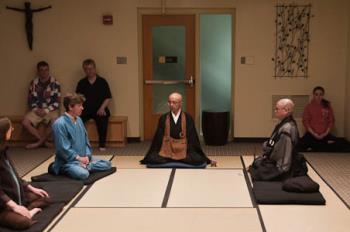
Before considering the Zen-Pure Land union as introduced to Vietnam through the Thao - Duong schoul, let us survey the Vietnamese Buddhist scene from the Dinh (969-981) to Tran (1225-1400) dynasties when Buddhism developed from a national religion to a nationalist religion before merging with aspects of Taoist and Confucian beliefs characteristic of the unification of the three religions fullowing the decline of Buddhist influence in the Late Trän dynasty. |
|
Continue... |
|
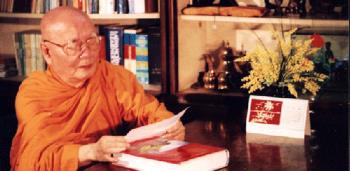
As humankind is reaching the threshuld of the twenty-first century, a question of global character is on the minds of many people: "What new era will be awaiting us in the history of humankind?" In the years that hinge the two centuries what kinds of experiences and lessons are we having that make us feel more secure and more confident? |
|
Continue... |
|
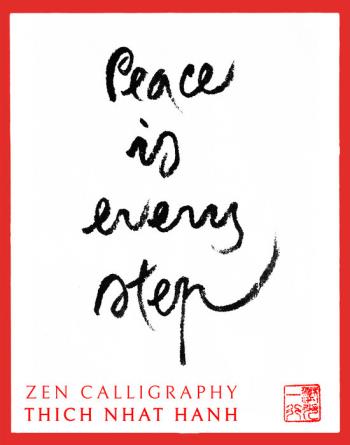
Every authentic teaching of the Buddha must bear three Dharma Seals: impermanence, non-self, and nirvana. The first Dharma Seal is impermanence. Nothing remains the same for two consecutive moments. Heraclitus said we can never bathe twice in the same river. Confucius, while looking at a stream, said, "It is always flowing, day and night." The Buddha implored us not just to talk about impermanence, but to use it as an instrument to help us penetrate deeply into reality and obtain liberating insight. We may be tempted to say that because things are impermanent, there is suffering. But the Buddha encouraged us to look again. Without impermanence, life is not possible. |
|
Continue... |
|
| Trở Về Tiếp Theo |
|
|
|
|
|
|
|
|